

Hunger as comfort
dispatch 9

Hi folks,
Thank you for bearing with me on my little hiatus! Life is weird and hectic isn’t it? Before I get into it, a content warning on today’s essay: I discuss food restriction and compulsive exercise. There are no details or specific behaviors, but if that doesn’t feel like something you can take in today (or ever), please skip this one and take care of yourself.
I’ve been riding some eating disorder cravings that I thought I left behind a decade ago lately. Noticing how when things are very much out of my control, I seek to control them any way I can. But, I am also finding the silver linings, moments to honor the healing I have done. When my new manager asked me this week, in preparation for an offsite, if I have any food restrictions I said no and meant it. Maybe for the first time, I didn’t panic about going on a trip and not being able to control my food options. I didn’t pack 47 supplements in some strange bid at compensation.
Performing health was a way of performing an idea of goodness for me. It was a was a way of making my queerness more palatable by making my appearance more palatable. In my drinking years, it was a way of covering for my drinking. In sobriety, it helped me to control my anxiety, giving me some small sense of control. It was a way I punished myself and a way I protected myself. Like anything about bodies it is complex and nonlinear. The string that you pull that moves the whole web.
My next bonus essay for paid subscribers will be zooming to your inboxes next Wednesday. Be sure to subscribe if you don’t want to miss it!
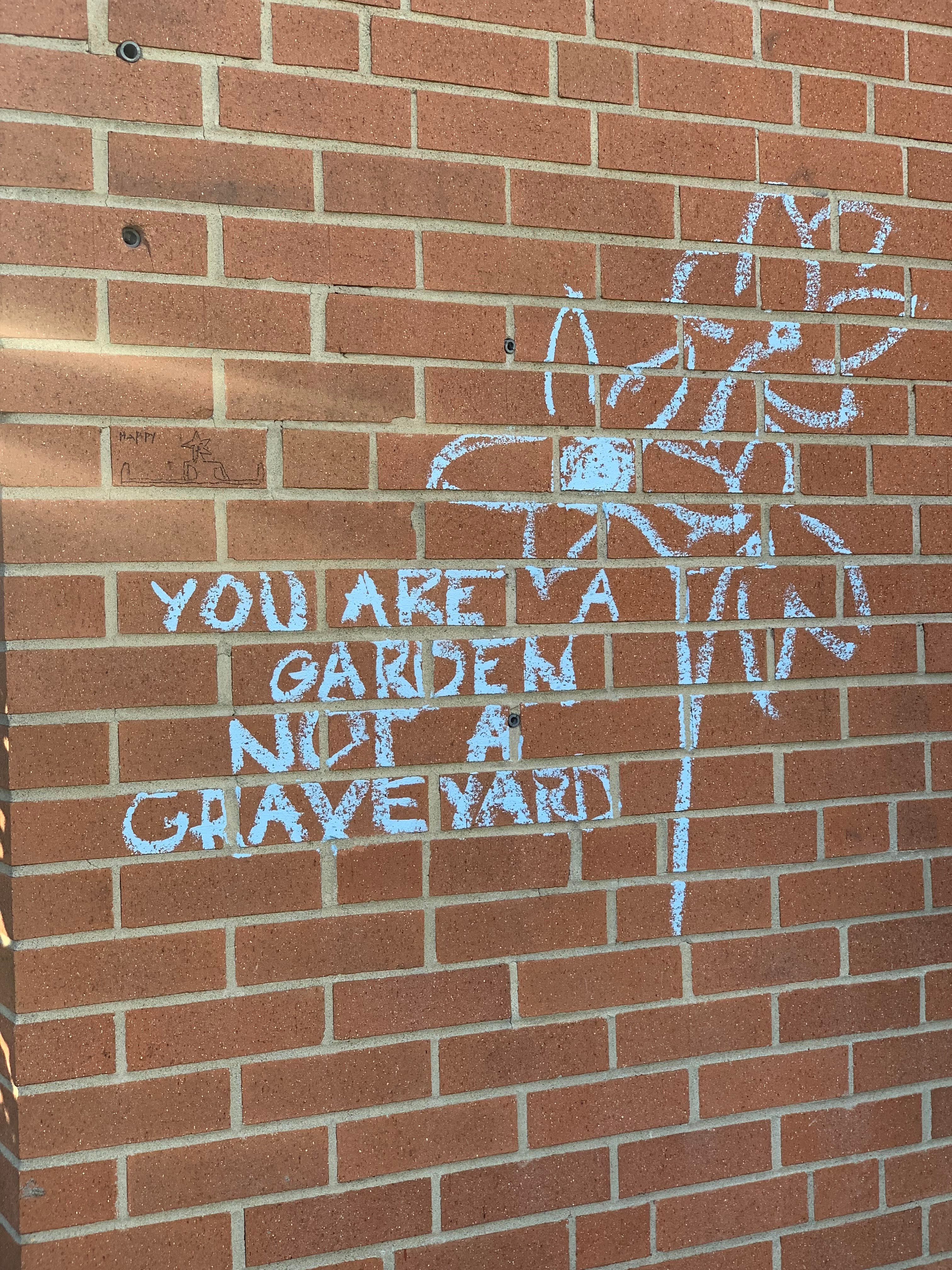
[Image Description: A cell phone photo of a red brick wall. In the middle of the image, written in blue chalk is a drawing of flowers and text that reads “You are a garden not a graveyard”.]
Hunger as comfort
I don’t remember going on my first diet. I do not recall the first time I measured my worth against how much denial I could withstand. But I do know that I have walked with hunger for so long that the space where she used to be feels empty, haunted. Without her, there are times when I feel alone, vulnerable, without the comfort of an old friend whose ways of hurting you are as familiar as your own hands. I know how to punish myself; release is harder.
In the years that I was 15 and 16, three major things happened that changed the course of my story. In the first, I came out as bisexual. Quietly, dismissively, less of a proud declaration and more of a footnote, I hoped that no one would notice and we could all just move on. I didn’t have a grasp of queerness yet and so I shrank from it, telling as few people as possible. In the second thing, I started skipping meals, running for hours on a basement treadmill to VH1 reruns of I Love The 80s. The third thing, I started to drink. In summary, I whispered the truest thing about me into the world at the exact same moment that I started to erase myself at the edges.
It makes sense then that in the aftermath of getting sober, my queerness became more forefront in my life and identity. That we found each other again when my voice and my hands no longer shook. It makes sense too that my disordered eating morphed and grew in sobriety, finding new strongholds in my newly made life. In the time since, I have been trying to leave it behind too. But restriction is my first love, and our ending has been complicated and long. It has not been a clean break.
In these, my first years of sobriety, I have come to an understanding of how these things worked in my life. The push and pull, the ways that drinking and managing my body provided control and release in a life that felt increasingly unmanageable. How that felt like a kind of safety, a comfort. There is something too about palatability. About the ways that queer people and people with addictions and any of us at any number of margins will look for ways to be acceptable, at least for a time. Ways that we try to prove our basic humanity to the people who least deserve it, over and over again.
Starving and drinking were how I survived, how I punished myself for all of the ways that I thought I was wrong. They were also how I fit in. Our culture thrives on the hatred and punishment of bodies, our own and others. Hurting yourself can be a kind of social currency, a way that you are just like everyone else. I am different from you, but in this way we are the same. We both worship something unreachable, we are both trying to disappear. Say you hate a part of you and notice how they breathe easier around you. This is a common story, an American story I think, and it is mine too. I thought that if I could make my body smaller and smaller, eat perfectly, crave nothing, that I would be saved. I eliminated acceptable foods until, even years into sobriety, nearly nothing was left. When you spend most of each day thinking about food, there isn’t much time for anything else. You become empty. And in that emptiness, you teach yourself that you cannot be trusted.
Sobriety didn’t end restriction for me, but it made me notice things. Like the first time I bought a loaf of bread in over 10 years, and I watched it go moldy on top of the fridge in my little apartment. In truth, the things I had not allowed myself terrified me. Weeks later, I bought a box of cereal, sobbed through my first bowl, not for fear of food but fear of myself. When the restriction was gone I had thought I would be feral. Want in the shape of a girl. The shadow of a thing can look so big that you miss the scared, small thing crouched behind it.
Since then, there have been layers to coming home to my body in all of this. Layers to realizing just how disconnected I had become and all of the ways I had subtly betrayed myself so that I could keep going. There are layers to forgiving myself for all of the ways I did not know and all of the ways I could not let myself know that there was more than this. For most of my life, I have viewed my body as a site of betrayal. Like some battleground you visit many years later, mostly cleared of evidence, but if you dig you can find things. The shell of a bullet, a button, the blade of a knife. The kind of place that feels full of ghosts even in daylight. I wish I could remember what it looked like before the haunting.
This is not a story with a tidy ending or a moral. There is so much I have not yet figured out. So many points of connection to myself that drinking dulled and restriction overrode, that I am remapping now at 33. When that kid abandoned herself she left no marked path back to what we were before. I imagine that in a way we are cutting a new one together in this healing.
One of my heroes and the matriarch of my queer creative lineage, Tove Jansson, once described her queerness this way: “That was when I realized, as we were dancing. It came as such a huge surprise. Like finding a new and wondrous room in an old house one thought one knew from top to bottom. Just stepping straight in, and not being able to fathom how one had never known it existed.” That is what healing feels like for me. Stepping into these new spaces that have felt barred from me for so long, though they always existed. Marveling that they are mine.
Because the truth is, I have nothing to fear from myself, not in the ways that I thought I did. There is nothing to punish myself for. We survive in the ways we can. We pull small comforts around our shoulders and don’t realize they can hurt us too. I am learning to trust myself, to trust that I will never leave me again, to redraw those edges in the boldest of ink and apologize for nothing.
Assorted, rad things:
I did a podcast! Scoot on over to The Jean Swallow Project to hear Max and I talk about all things friendship & queerness on The Sober Goons pod. I may sound like I played it cool but I was deeply nervous and sweaty, as is my brand.
Don’t Project Your Insecurities on Me on the Absolutely Not! Podcast: A lot of times companies have showy DE&I policies but when it comes down to the moment of actual boundary setting, the policies seem to not apply. Loved this conversation on setting workplace boundaries as a tool of naming, repairing, and avoiding future harm.
The Gentle Art of Swedish Death Cleaning by Margareta Magnusson: A friend mentioned this on a call recently and I immediately put in a library order because while I hate tidying, I like to think I am a person who likes it? Meaning that rather than actually doing it, I read books about it. I expected this book to be wholesome and earnest, instead it included talk of erotic toolsheds and such nuggets as “Save your favorite dildo but throw away the other fifteen”. It was no-nonsense and emotionally unattached, which made my Swedish heart soar.
Not a thing per se but a question: Why does so much wall decor about straight ladies murdering their husbands exist? Are y’all okay? Blink twice if you need rescue!
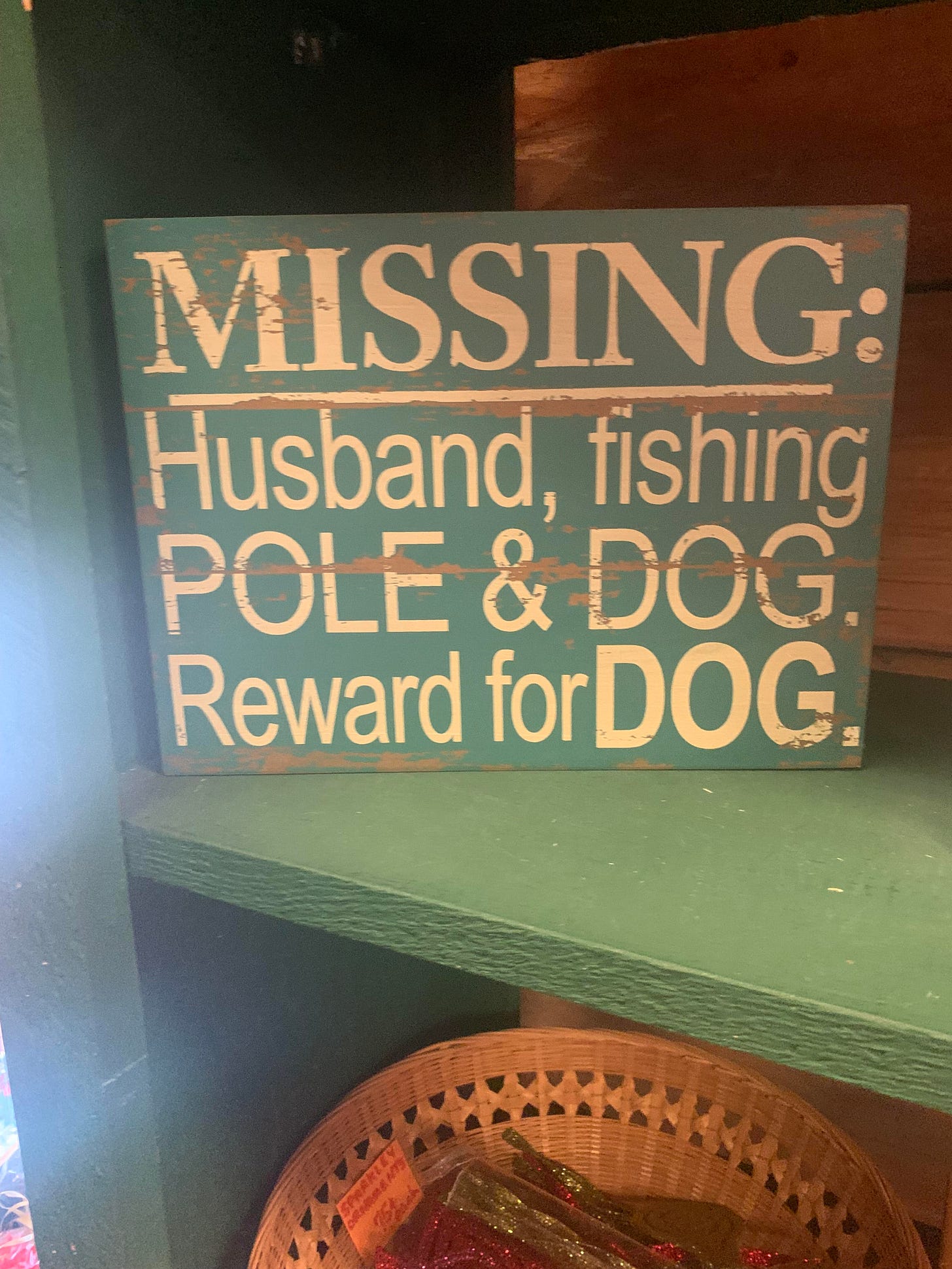
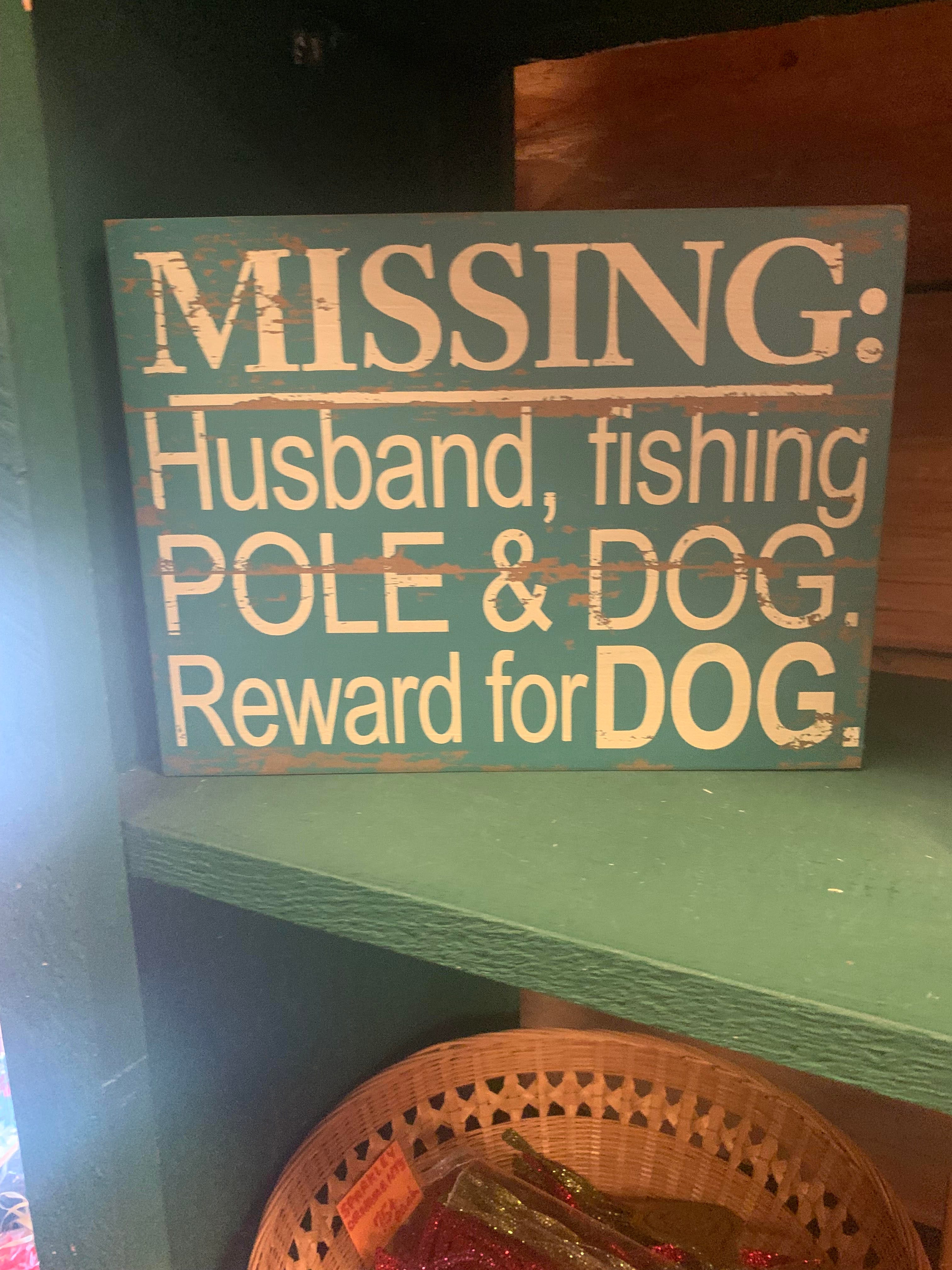
[Image Description: A photo of a blue sign sitting on a green shelf that says “Missing: husband, fishing pole, and dog. Reward for dog.” ]
This newsletter is reader-funded, the small percentage of folks who pay make this whole thing possible. If you’d like to subscribe for additional dispatches, you can check out the available plans at the button below. Sharing is encouraged and appreciated. Feel free to send snoozeletter to a friend if you think they’d enjoy my work.
Questions, comments, or want to show me some straight-lady-murder decor you find in the wild? Hit reply. I’m thinking of curating an exhibition.
always,
lisa
“So many points of connection to myself that drinking dulled and restriction overrode, that I am remapping now at 33.” so much identification here, Lisa ♥️🙏🏻