

one about the men
dispatch 45
Snoozeletter is officially 2! I can’t believe it. Writing in this space has been a game changer for me in terms of taking myself seriously as a writer, feeling accountability to my creative practice, and just shifting how I am in the world. Thank you for being along for the ride.
I still am not 100% sure what the theme here is…other than just the wild swirlings of my tornado brain (Mar Grace’s phrasing of “tornado person” resonates DEEPLY), I know that showing up here to do it is shaping me. I know that whatever comes next will be because of what I am learning and practicing here.
An unintentional theme of this newsletter has become my relationships with the women in my family, and over two years I have never written about the men because I have never known what to say. This is a start.
This month I’m running discounted subscriptions to celebrate 2 years of snooze. If that feels interesting to you, just sign up below and it will be applied automatically. The funds from paid subscriptions support my ongoing work (tools, time, a whole lot of coffee) and help me give to causes I care about. This month, I’m donating 100% of my income from the newsletter to Sunserve Youth, a Florida LGBTQ+ youth organization close to my heart. As always, if you want to receive additional dispatches but aren’t able to afford a subscription, reply to this email and I’ll get you added.
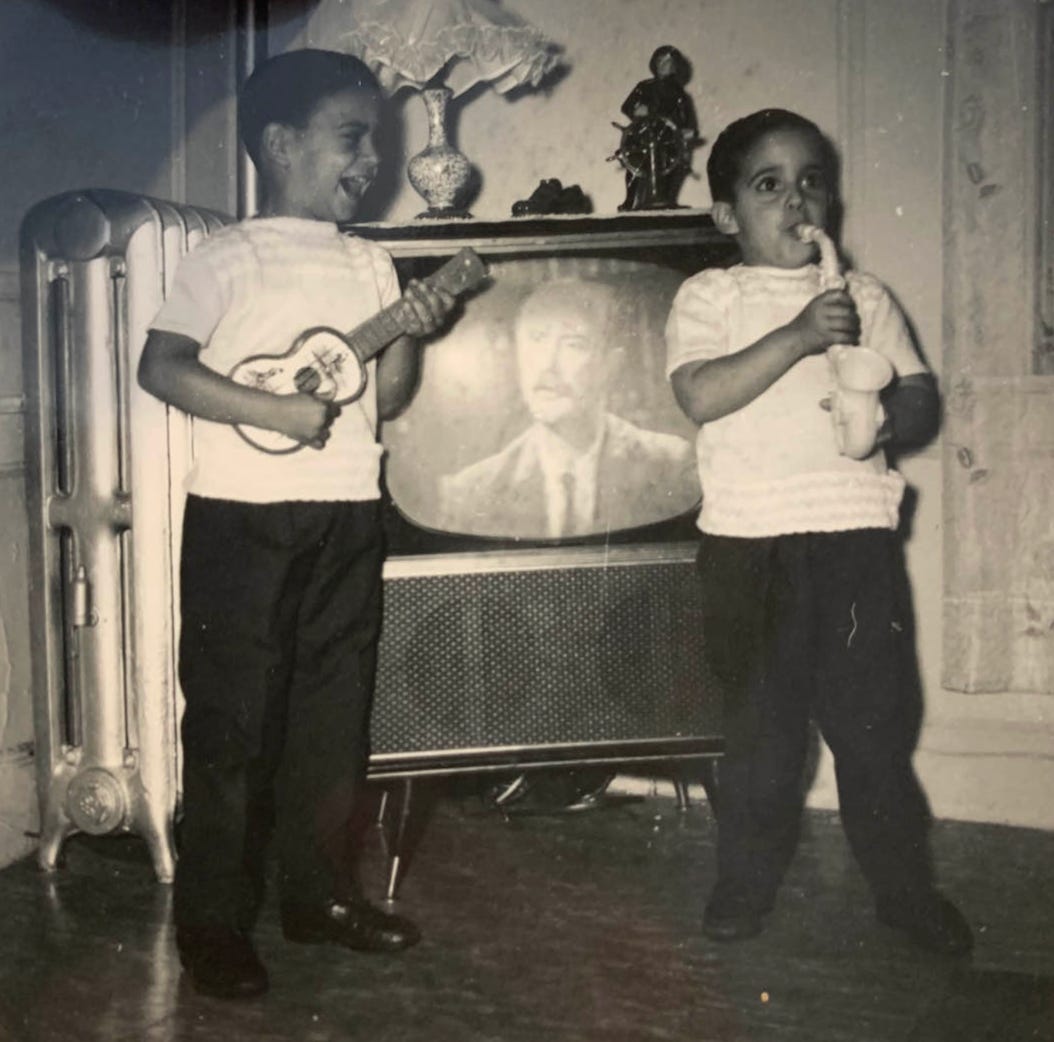
one about the men
The men were always leaving. Even when they were there, it is their absence more than their presence that punctuated my family’s life which was maintained and shaped by the women. That is reductive, but it’s true. I hate when reductive things are true.
The men did blue-collar jobs or work in the trades and in some way or other their work always involved putting their bodies on the line. This made me think they were very strong, and I suppose they were. They left for work, never for leisure, except for an annual hunting trip that rarely resulted in any hunting, for which I was glad.
But there is family lore about the one time my uncle dragged a deer carcass up my grandmother’s driveway, the only animal they ever killed. Its head still hangs over my grandmother’s staircase, haunting my family for decades. I don’t like to look at it, the glass eyes are too sad, and I don’t like what it reveals about who we are as a family or more truly, who we have tried to be.
The men were loud, boisterous. I could not imagine them resting, and so it was always shocking to see them on holidays, bodies folded over couches and recliners in my grandmother’s living room. There was a physicality to them that was tied to strength and was therefore acceptable to me, and so when they lifted my small child body in the air, holding me upside down to kiss my cheek, I was delighted. It made me feel tiny and protected, safe in a way that men have not made me feel in all of these years since.
I barely remember my paternal grandfather. I remember things about him and the general shape of him, but I did not know him well in the years before he died. He was different from his sons. He played the mandolin, made landscape oil paintings, talked history with my mother, and folded tiny, intricate model ships into glass bottles which seemed a particular kind of sorcery. He put ketchup on everything in a way that embarrassed my father deeply. For my father, a love of ketchup was an unforgivable class flag that would out us in public. He worried that, if one day we happened to find ourselves in a fancy restaurant, my grandfather’s love of ketchup would show the ways in which we had only recently started to belong. Decades later, my cousins and I still pour ketchup on everything, some part of our bodies remembering. We did not grow up in poverty and so to us, ketchup can just be ketchup, and not a betrayal.
What I do remember of my grandfather is that he did not seem to approve of me. He yelled at and about me in Portuguese, to my grandmother who would always take me away to her sewing room. He did not like to be disturbed and I was frequently disturbing. I do not know if he liked children. I say that so I do not have to say what I mean, which is that I do not know if he liked me.
My father is one of three brothers, the oldest in the way that I am now the oldest of my blended family. He is a mechanical genius, one of those people who can fix absolutely anything at all if he gets his hands on it. If he were white and wealthy, he might have been an engineer. I am glad he is not…when he fixes things now it is like art, unconstrained by institutional knowledge. He is meticulous, careful, and always doing things in the most correct way. These behaviors of control are things I recognize in myself, the way we cover our anxiety with competence.
My father is present now in a way that comes with time and experience, and in a way that he couldn’t be when I was a child and money was tight and he was trying to build a life for us off of his mind and his body. Sometimes, in my worst moments, I envy that presence and how it stabilized only once I had moved away. To say the absence was total would be both unfair and untrue, I have many memories with my father. Memories of him reaching across the table of a Friendly’s booth to hold my nose shut as I tried to drink my milkshake, making me giggle so hard I almost choked. He did it every time, but I always acted surprised. I liked to have his attention on me, and on the Wednesdays that my mother worked late, it was our time. I cherished it.
For as much as he is serious, he has always been a trickster. One morning, while the local radio morning show blared through the house, he reworked the lyrics to The Backstreet Boys “Show Me the Meaning of Being Lonely” to “Show Me the Meaning of Eating Bologna” and I was sure he was the cleverest person I had ever met. I still love to change the words of songs to make them just a little bit sillier.
The best days were when he would bring me to work with him. I would sit on the brown metal toolbox in the back of his work van, my feet dangling towards the floor and a bungee cord across my waist in a nod towards a seatbelt. I’d hit the heels of my little work boots, imitations of his, against the cool metal side and hear its hollow echo. How many days did I spend wandering around his job sites, all drop cloths and cut wood smell? Singing in the car to every Jackson 5 song we heard. Well into my 20s, he would call me every single time he heard one of those songs on the radio. But that does not happen anymore. Once, he found a treasure trove of antique bottles underneath a mansion he was working on in Eastern Long Island, Gatsby country. They were filthy and the three of us, my father, my mother, and I scrubbed and scrubbed them until they shined in our pruned fingers. I don’t know what happened to them after, but the memory is enough.
I don’t write about the men in my family because it was hard to know them. It is still hard to know them. They stood at the edges and I didn’t know how to miss them, just knew that I did.
Looking back at 2 years:
Here are some my favorite essays from the last 2 years, in case you want to revisit them!
I don’t take shelter in dead things: On divorce and rebuilding on the other side, this is probably the essay that felt most vulnerable to share
intentional joy: On seeking tiny moments of joy and pleasure
learning to be useful: On volunteering at the library
it will feel beautiful: On generations and mothering
on love and time: Exactly what it sounds like
Assorted, rad thing(s):
A section of this newsletter where I share what I have been reading, watching, or otherwise consuming lately.
When you meet the monster, anoint its feet by Báyò Akómoláfé on the Emergence Magazine podcast: There are no words for how deeply beautiful this audio essay is. On queering the idea of monstrosity, colorism, and identity though it is so much bigger somehow. If you take one thing from today, please listen to this. I am keeping this as my only item for the week because I truly want you to listen to it that badly.
Whew, what a ride. From this little perch I have to say that if there is something you want to do, go do it. Start, even if you start in the smallest way. Even if it doesn’t look like it’s “supposed” to. Just start and start and start again.
here’s to two more,
lisa
This newsletter is reader-funded, the small percentage of folks who pay make this whole thing possible. Big thanks to those who support my work in all of the ways. Sharing is encouraged and appreciated. Feel free to send snoozeletter to a friend if you think they’d enjoy my work.