

the sea inside
dispatch 44

I’m back baybee! I missed being here but am still feeling oh so grateful for the chance to take a break. In my downtime I started volunteering with a farming and land justice nonprofit, took some writing workshops, finished a goth-stitch (gothic-themed cross-stitch) and had some professional life realizations. My life is in a moment of change and I am recognizing that as a very good thing.
When you read this, I’ll be on a train traveling to see my very best friends for the first time in years. Ain’t that big love story kind of friendship the best? (Yes.) Anyway, today’s essay is about an exhibit we saw on a recent trip that I still can’t get over.
This month I’m running discounted subscriptions to celebrate 2 years of snooze. If that feels interesting to you, just sign up below and it will be applied automatically. The funds from paid subscriptions support my ongoing work (tools, time, a whole lot of coffee) and help me give to causes I care about. This month, I’m donating 100% of my income from the newsletter to Sunserve Youth, a Florida LGBTQ+ youth organization close to my heart. As always, if you want to receive additional dispatches but aren’t able to afford a subscription, reply to this email and I’ll get you added.
the sea inside
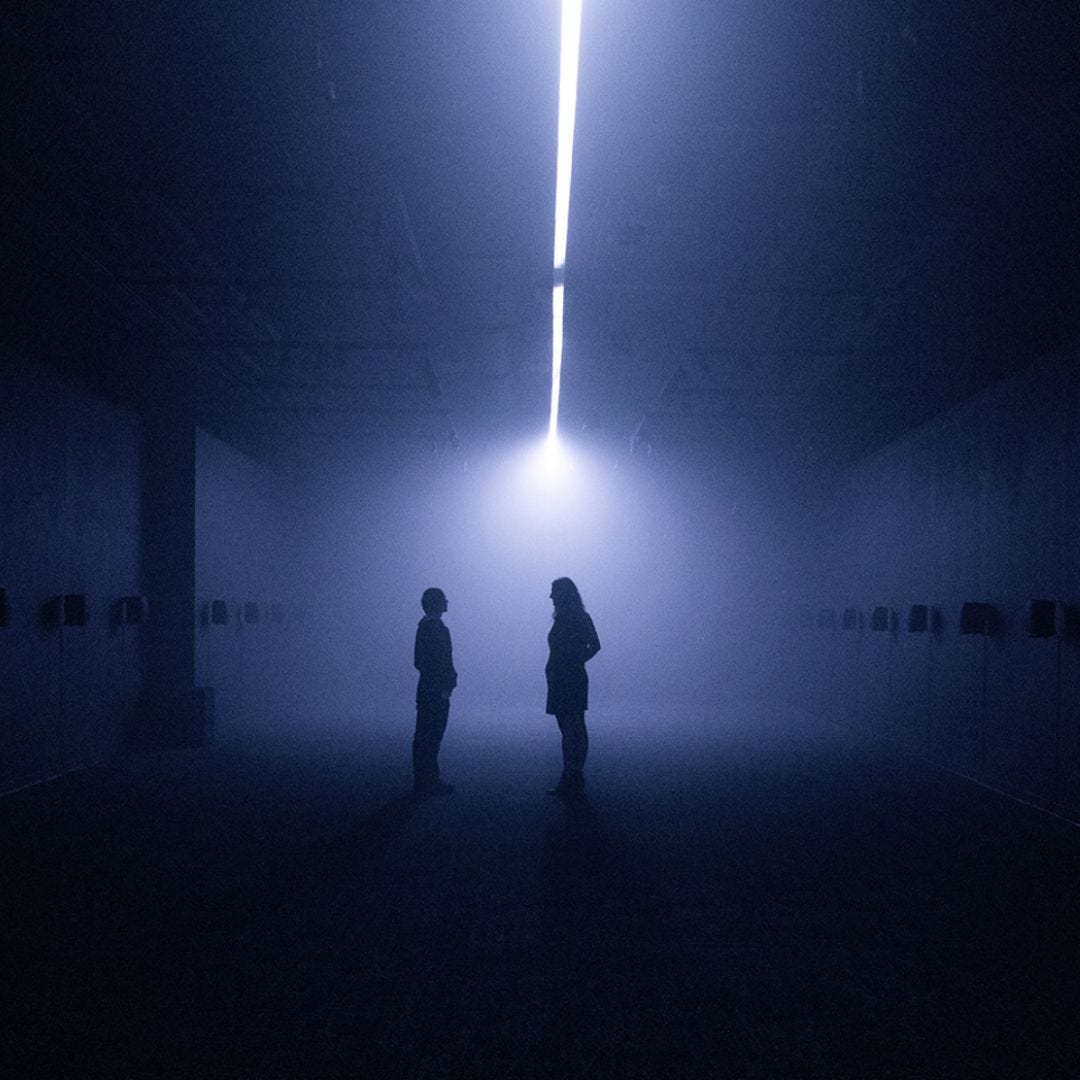
I walk into a dark room and the door closes behind me, slicing out the light from the atrium with all of its too-white paint. The dark gathers the room close, though I know instinctively that it is a big space. I notice the mist first, how it smells briny in a way that can only mean the sea. It smells like digging raw hands into sand. It smells like my childhood and all of those years of taking the beach for granted. It unnerves me to find the sea in this place, and I reach for my love’s hand in the dark. We walk a few steps in a direction that feels like forward, but we are already lost. Space collapses in the dark.
The room is long and when the sound rips through it feels like you’re under a wave, the effect amplified by a single strip of light rolling across the ceiling, back and forth. Speakers line the walls, but you can only see them for the brief seconds that the light moves over you. It doesn’t break the illusion that’s been carefully crafted, that you are of the sea now. I do not know these waters, but I know the Atlantic, and I can feel the haunt of her in the ghostly voices of the choir playing from the speakers, cutting through the wave sounds.
This is FLÓÐ, an art installation and immersive piece by the artist Jónsi, about cities that entwine with the sea and the impacts of climate change. I love it so much that we go through it twice. It is disorienting to be in the dark, following sound, but I like to be disoriented. It feels good to be shaken to my bones. It is nice to move slowly and carefully through a space. To perceive without being perceived. To observe with all of me and find myself in my body. This is awe, and I am grateful. The sound climbs the walls and it all becomes too much. I cannot stay here, it makes me feel too powerful.
When we went to Seattle, I didn’t know that my people had come here centuries ago. Seattle and its surrounding areas are still a haven for Nordic immigrants and their descendants. You can find it in the names, the murals, and the culture of the place. I grew up on the opposite coast, surrounded by descendants of Irish and Italian immigrants who had come to America so long ago that they often had no ties to what came before. I am a first-gen kid, born lonely, longing for a place I’d never been. The experience of being of two worlds means feeling the lack of a whole, a straddling that continues to echo through the ways I perceive the world. I grew up on stories of gods and serpents and ships full of warriors who did not fear death, but I did not grow up knowing how to be Nordic. I did not grow up knowing history or custom. My parents, like so many before them and so many after, had set upon the immigrant task of folding themselves into the grand illusion of The American. Any connection to what came before was meaning that I had to make myself, slowly over the decades after my fingers first troubled the tender edges of its absence.
What I do know is that I love the sea, that I laugh at dark things, that I have an extreme fondness for candlelight and cardamom. I know that I am built for cold, though I absorb heat like a lizard and am always warm to the touch. I know that there is the flare of the trickster at the center of who I am becoming, which is who I have always been. I know that I am born, on both sides, from people of the sea and I have learned my way back over these years towards what I would make my own. The sea is the single place that will always feel mine. I will always belong to it. And it seems to love me back violently, in that I cannot count the number of times I have almost been claimed by riptides since before I learned to swim.
And now, in this room, in a building full of all of the art and history that I didn’t know I needed, there is this room of the sea. It is something familiar in its volatility. It is something I can hold onto, a homecoming, and a recognition. It grounds me in my overwhelm.
I will think about that dark room every single day after I leave it. The womb of it, the audible fury of the water, that salty mist. How the singing wound around my insides and held them tight. This somehow-perfect depiction of how we have, collectively, always been at the mercy of the sea, even as we have treated her badly.
Nordic people came to this place en masse because it reminded them of home. They came because they had the skills needed to survive and make a living in this brutal and gorgeous terrain. They came, because of the sea, a different sea to be sure but I like to think that they stayed because they needed salt on skin and the kind of air that has heft. I like to think that, like me, they sought something they recognized. They sought a reflection of themselves so that they might know that they were home.
Assorted, rad things:
A section of this newsletter where I share what I have been reading, watching, or otherwise consuming lately.
Simply Julia: 110 Easy Recipes for Healthy Comfort Food: In this house Julia is simply The Tursh and we turn to her recipes at least a few times per week. Every recipe is delicious, fairly simple, and won’t make you use two bowls when one is fine. Woven in are reflections and stories from Julia’s volunteering gig, talks about her eating disorder recovery, and her relationship with her wife. If you, like me, recoil with a hiss from anything that says “Healthy” in the title, know that this is meant in a broad and self-determined way. Get it for yourself, get it for your mom, get it for everyone you know. You will love it, promise.
Morgan Harper Nichols on art and perception on the How We Live Now podcast: Katherine May’s podcast is one of my favorites and this episode was an especially good one. They discuss getting their autism diagnoses in adulthood, making art from how they perceive the world, and of course, enchantment.
Welcome to America by Linda Boström Knausgård: In February I wrote about volunteering at the library and it remains one of the best times of my week. During a night of shelf-reading (making sure the books are neat and in order in a particular section), I came across this little book. I know of Linda from her ex-husband’s writing and she seemed like a mythical figure to me. I guess I grabbed this book because I wanted to get to know her. It’s a brutal and beautiful book about a girl who stops speaking when her father dies, after wishing for his death. Her little family reforms in the aftermath, all reaching and prickly edges. I loved it.
What a joy to step away and have a space to come back to. Thank you, all of you, for being here.
with gratitude,
lisa
This newsletter is reader-funded, the small percentage of folks who pay make this whole thing possible. Big thanks to those who support my work in all of the ways. Sharing is encouraged and appreciated. Feel free to send snoozeletter to a friend if you think they’d enjoy my work.